Resources
The Hingepoint Framework is published as files anyone can read, review and circulate. There is no paywall, no registration and no gated download.
Two licenses, on purpose.
The Guide and the Manifesto are licensed under Creative Commons Attribution-NoDerivatives 4.0 (CC BY-ND 4.0): copy and redistribute them in any medium or format, for any purpose including commercially, provided you give credit and pass them on unmodified. Quotation with attribution is expressly welcome. They are normative — a forked Guide claiming to be the Guide would make the framework mean two different things, which is exactly what "normative" exists to prevent.
The Hingepoint SKILL is licensed under Apache-2.0, and that difference is deliberate. It is a working instruction for an AI agent, and it is meant to be adapted: to your repositories, your tooling, your governance rules, your house style. Copy it, change it, commit it into your own project. That is the intended use, not a tolerated one.
Adapt it freely. An adapted SKILL is your own — when presenting or publishing it, make clear it was modified by you.
Adapting the framework inside your own organization is likewise not redistribution, and needs no permission from anyone.
The Hingepoint Guide
The Guide is the normative reference for the Hingepoint Framework. It defines the principles, the concepts, the phases, the artifacts, the verification and validation activities, and the organizational model. Where anything else disagrees with the Guide, the Guide is right.
It is also the best starting point. If you read one thing about Hingepoint, read this: it explains why the framework exists and how its parts fit together, without prescribing tools, technologies or vendors.
The same text is published as Markdown as well as PDF. Point an AI assistant at the Markdown and it reads the framework itself rather than a summary of it.
The Hingepoint Guide
The normative reference. Start here.
The Tandem Manifesto
The Manifesto describes how collaboration between humans and AI should be shaped, taking seriously the strengths and the weaknesses of both. The result is a working agreement between software engineers and AI agents — fourteen recognitions and commitments, short enough to agree on and short enough to remember.
It came out of the same practice the framework did.
Read the Manifesto
All fourteen points, rendered from the source document itself.
Machine-readable
The same file this site renders. For agents, and for quoting exactly.
For circulating
Two pages. Print it, or send it to someone who does not read Markdown.
For your AI agent
Humans learn the Hingepoint Framework through the Guide, through training and through practical experience. AI learns the framework through machine-readable instructions.
A machine-readable working instruction teaches an agent the Hingepoint way directly, so that the process is shared by the whole team rather than only by the humans on it.
Licensed Apache-2.0, unlike the Guide and the Manifesto. Adapt it to your own repositories, tooling and governance rules — and when you publish an adapted version, say that you changed it.
Version 1.0.0 ships as a bundle: the working instruction itself, five templates (spec, plan, hingepoint register, insight register, acceptance brief), and a reference on Evolution. Install the archive, or read the instruction on its own first.
Diagrams
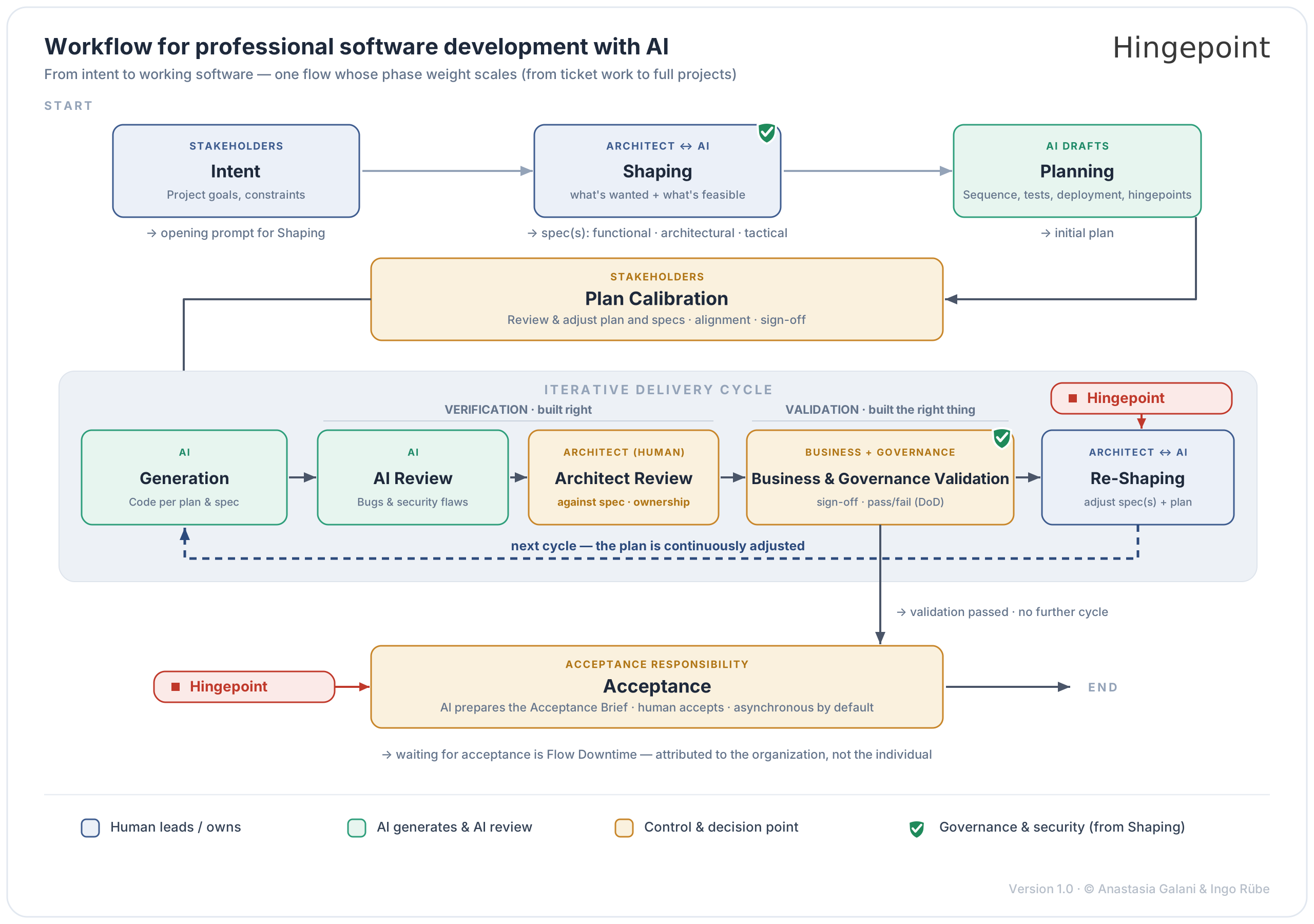
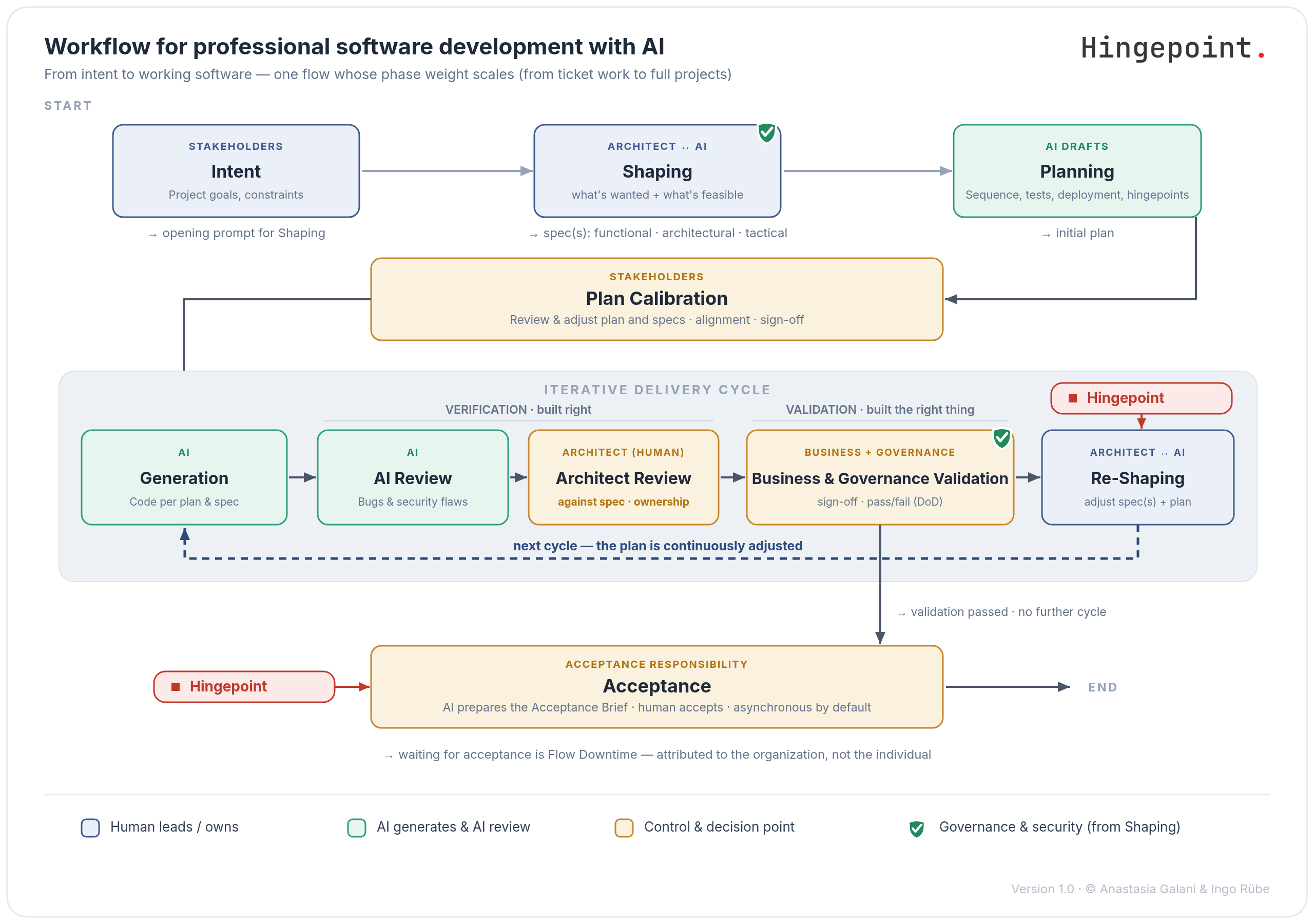
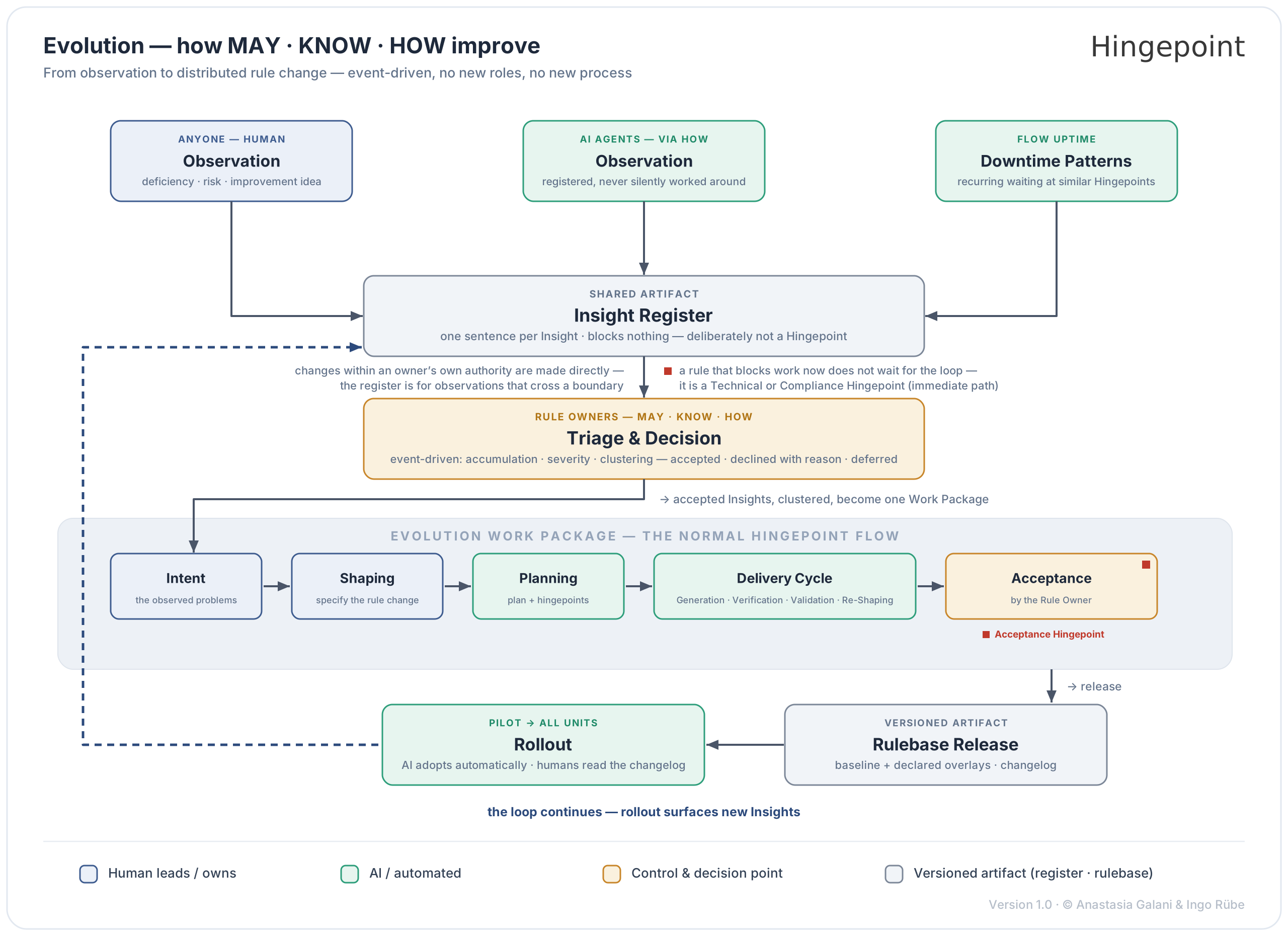
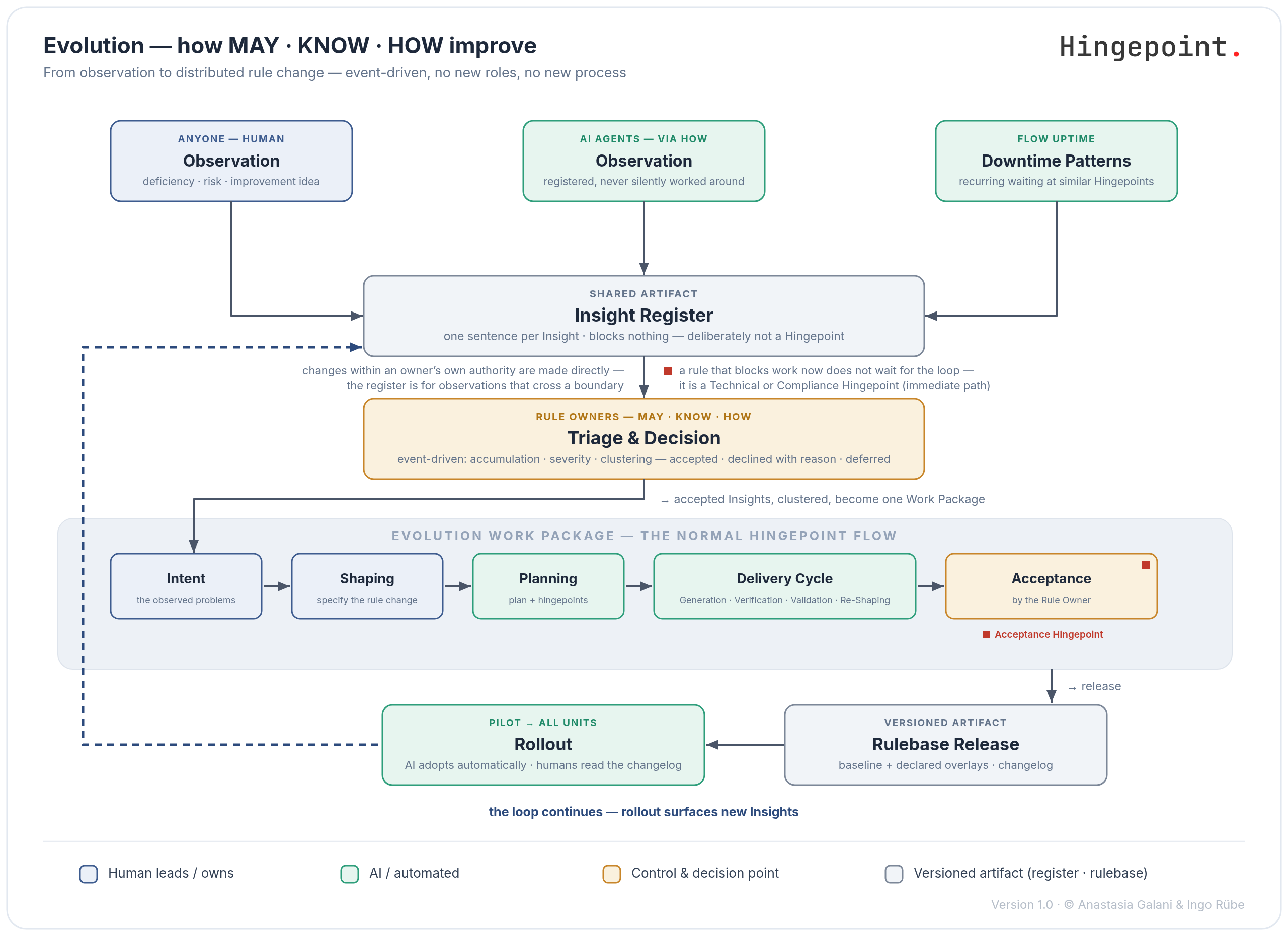
For reference, the two diagrams used in the Guide.
The Hingepoint Flow
The Ramp prepares, the Delivery Cycle builds, Hingepoints synchronize.
The Evolution Flow
How the rules improve — from observation to distributed rule change.
Contributions from the community
The community produces useful things: companion guides, templates, checklists, tooling, translations, write-ups of how a particular organization adopted the framework. We would rather point at them than pretend they do not exist.
But it has to be obvious which is which, so the distinction is made in one place and kept:
- Authoritative
- The Hingepoint Guide, the Tandem Manifesto and the machine-readable artifacts. Written and published by the authors, versioned, and normative. Where anything disagrees with the Guide, the Guide is right.
- Recognized
- Work by community members that we consider good and worth finding. Clearly marked as a community contribution, credited to whoever made it, and not part of the framework definition. Recognition means "we think this is useful", not "this is the framework".
If you have built something you would like listed, bring it to the community first — that is where it gets read and discussed. Nothing becomes authoritative by being useful.
Governance
The community proposes changes and amendments to the Guide and to the machine-readable artifacts. Authority to publish currently rests with the authors, who remain responsible for what the framework says.
As the community grows, the authors will establish an advisory board drawn from active community members. Evolution is part of the framework itself — the Guide is expected to change as practice accumulates, and the mechanism for that change is described in the Guide.
License and trade mark
The Guide and the Manifesto are licensed under CC BY-ND 4.0 — free to share, not to fork. The Hingepoint SKILL is licensed under Apache-2.0 — free to adapt, provided an adapted version says so.
Hingepoint is a trade mark of the authors, EU trade mark application pending. The license grants no trade mark rights: using the mark for trainings, certifications or related offerings requires a separate agreement — see Become a trainer.